
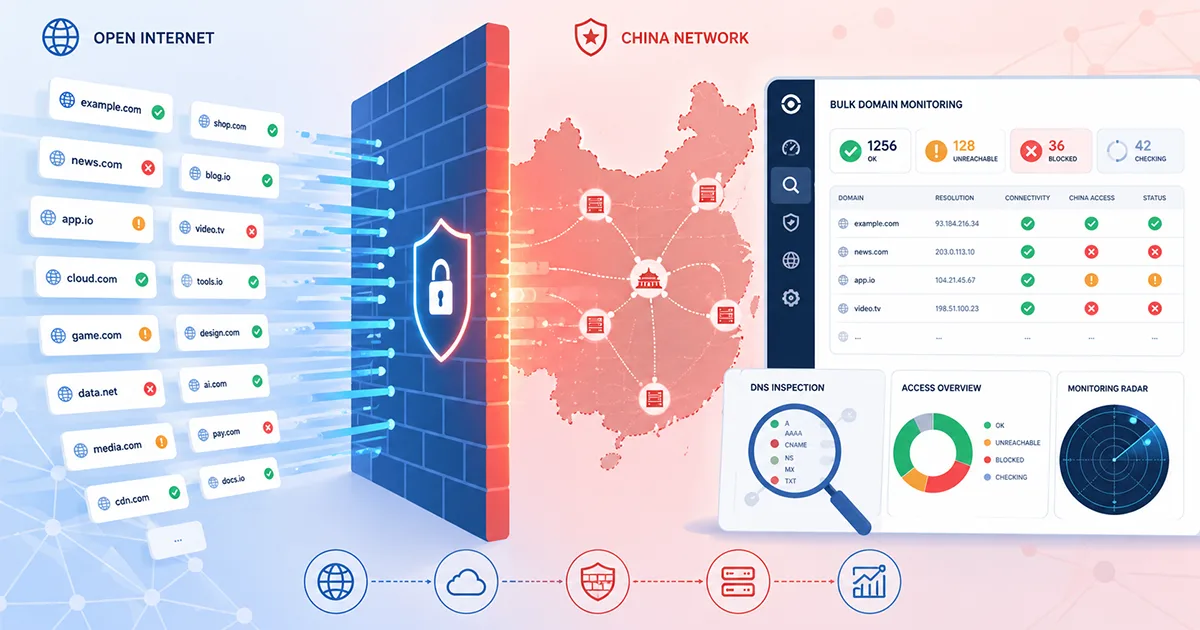
A Bulk and Automated Platform for Detecting Domain Hijacking and DNS Pollution in China
If your website, SaaS product, API service, e-commerce store, affiliate landing page, or online platform serves users in China, testing your domain from overseas is not enough.
A website may work perfectly from the United States, Singapore, or Europe, while users in mainland China experience:
- DNS resolution failures
- Incorrect IP addresses
- Unexpected redirects
- ISP-level hijacking
- Timeouts or connection resets
- Different results across regions and carriers
- Advertising traffic that clicks but cannot reach the landing page
These issues are often not caused by your server, application, or hosting provider. They may happen inside the Chinese network environment, especially at the DNS, ISP, or regional routing level.
For a website with only one or two domains, manual checking may still be possible. But if you manage dozens, hundreds, or even thousands of domains, manual testing is inefficient and unreliable.
That is why businesses need a bulk and automated platform to detect domain hijacking, DNS pollution, and access anomalies from a China-network perspective.
Why China-Specific Domain Monitoring Matters
Many website owners use global uptime monitoring services. These tools are useful for detecting server downtime, HTTP errors, expired SSL certificates, and application failures.
However, they usually do not reflect the real access experience of users in China.
Chinese users access websites through local DNS resolvers, domestic ISPs, regional networks, and cross-border connectivity. Any abnormal behavior in this path can cause a domain to fail, even when the same website works normally from overseas.
1. DNS Pollution
DNS pollution happens when a domain returns an incorrect DNS result in certain network environments.
For example, your domain should resolve to your server IP address, but users in China may receive an invalid IP, wrong IP, or unreachable address.
The result is simple: your website works overseas, but users in China cannot open it.
2. Domain Hijacking
Domain hijacking may cause users to be redirected to an unexpected page, advertising page, warning page, or unrelated server.
For e-commerce websites, affiliate sites, landing pages, download sites, SaaS platforms, and content businesses, this can directly damage conversion rate, user trust, and revenue.
3. ISP-Level Hijacking
The same domain may behave differently across different networks.
For example:
- China Telecom works, but China Unicom fails
- Beijing works, but Guangdong fails
- Mobile networks fail, but broadband works
- One DNS resolver returns the correct IP, while another returns a polluted result
Without testing from real China-side network conditions, these problems are difficult to identify early.
4. Managing Domains at Scale Is Difficult
Many businesses do not operate only one domain.
Cross-border e-commerce stores, SEO teams, SaaS platforms, traffic networks, API providers, and affiliate businesses often manage many types of domains, including:
- Main website domains
- API domains
- CDN domains
- Static asset domains
- Advertising landing page domains
- Backup domains
- Customer custom domains
- Affiliate tracking domains
- Short link domains
If only part of these domains become polluted, hijacked, or inaccessible in China, the business impact can still be significant.
Who Needs Bulk and Automated Domain Pollution Detection?
Overseas SaaS and Tool Websites
If your SaaS product serves Chinese users but is hosted outside China, you need to know more than whether your server is online.
You need to know whether users in China can actually access your login page, dashboard, documentation, API endpoint, and payment flow.
If a domain is polluted or hijacked in China, users may fail to register, log in, call APIs, or complete payments.
Cross-Border E-Commerce and Independent Stores
Cross-border e-commerce businesses often depend on paid ads, SEO, social traffic, and landing pages.
If users click an ad but cannot open the page in China, advertising budget is wasted and conversion rate drops.
For Shopify stores, WooCommerce websites, independent e-commerce platforms, and self-hosted stores, it is important to monitor:
- Whether the main domain is accessible
- Whether landing pages are hijacked
- Whether CDN assets load correctly
- Whether DNS results are consistent across networks
- Whether pollution appears in specific regions or carriers
SEO, Affiliate, and Traffic Teams
SEO and affiliate teams often manage a large number of domains.
Manual checking is slow, inconsistent, and easy to miss.
Automated bulk detection helps teams quickly identify:
- Which domains are polluted
- Which domains are hijacked by ISPs
- Which domains fail in certain Chinese regions
- Which domains need DNS, CDN, or backup-domain adjustments
For businesses that depend on search traffic, affiliate revenue, and content distribution, domain accessibility is part of the revenue infrastructure.
Enterprise IT, Operations, and Security Teams
Corporate websites, customer portals, business systems, API gateways, and help centers often rely on multiple domains.
If your company has Chinese customers, partners, or employees, global uptime monitoring alone is not enough.
Operations teams need to discover problems before users report them.
A China-focused domain monitoring platform can turn DNS pollution, hijacking, and regional access failures into measurable operational alerts.
API and Platform Service Providers
For API providers, the biggest problem is not only that a web page cannot open. The bigger risk is that customer systems cannot call your service.
If an API domain resolves incorrectly in China, customer systems may experience request timeouts, unavailable endpoints, failed callbacks, or unstable integrations.
These problems may not be detected by standard uptime monitoring because overseas checks may still pass.
For API providers serving China-related customers, China-specific domain detection should be part of the basic monitoring stack.
What Should a China-Focused Detection Platform Provide?
A practical platform for detecting domain pollution and hijacking in China should do more than ping a domain or load a webpage once from an overseas server.
It should provide the following capabilities:
1. Bulk Domain Detection
Users should be able to submit many domains at once instead of checking them one by one.
For teams managing large domain portfolios, bulk detection is essential.
2. China-Side Network Perspective
Detection should reflect the real access conditions of Chinese users.
If all monitoring nodes are located overseas, it is difficult to detect China-specific DNS pollution, ISP hijacking, or regional network issues.
3. DNS Resolution Analysis
The platform should check how a domain resolves in different network environments and identify abnormal, incorrect, or suspicious DNS results.
4. Access and Hijacking Detection
DNS results alone are not enough. The platform should also check HTTP and HTTPS access behavior, including:
- Whether the website opens normally
- Whether it redirects to an unexpected page
- Whether it returns abnormal status codes
- Whether the request times out
- Whether SSL errors occur
- Whether page content appears inconsistent with expectation
5. Automated Monitoring and Alerts
A domain that works today may fail tomorrow.
DNS pollution, ISP hijacking, and regional network issues can happen at any time.
The platform should support scheduled monitoring and timely alerts when abnormal results are detected.
6. API Access
For enterprises, operations teams, SaaS platforms, and large-scale domain managers, API access is important.
With an API, detection results can be integrated into internal systems, dashboards, incident workflows, monitoring platforms, or automated operations.
7. Clear Detection Reports
Useful reports should not only show “success” or “failed.”
They should explain:
- Which domain is abnormal
- Which region or network is affected
- What DNS result was returned
- Whether DNS pollution is suspected
- Whether domain hijacking is suspected
- Whether HTTP access is normal
- When the issue occurred
- Whether the domain later recovered
How Weavebit Helps Detect Domain Issues in China
Weavebit focuses on domain detection from a China-network perspective.
It helps website operators, SaaS companies, e-commerce businesses, SEO teams, API providers, and enterprise operations teams discover DNS pollution, domain hijacking, ISP hijacking, and access anomalies earlier.
With Weavebit, you can:
- Detect multiple domains in bulk
- Monitor domain status from a China-side perspective
- Identify DNS pollution and abnormal resolution
- Detect suspected ISP hijacking or access anomalies
- Run scheduled automated checks
- Integrate results through API
- Discover risks before they affect more users
For websites serving Chinese users, domain accessibility in China is critical but often overlooked.
Global monitoring tells you whether your server is online. China-focused monitoring tells you whether Chinese users can actually reach your website.
Conclusion
If your business serves users in China and depends on multiple domains, APIs, landing pages, CDN domains, or promotional links, you need more than standard uptime monitoring.
You need a monitoring approach designed for China’s real network environment.
Bulk and automated domain detection helps you discover problems earlier, reduce manual troubleshooting, improve service stability, and avoid user loss, wasted ad spend, or failed API calls.
Weavebit is built for this use case: helping teams continuously monitor whether their domains are polluted, hijacked, or inaccessible from China.