
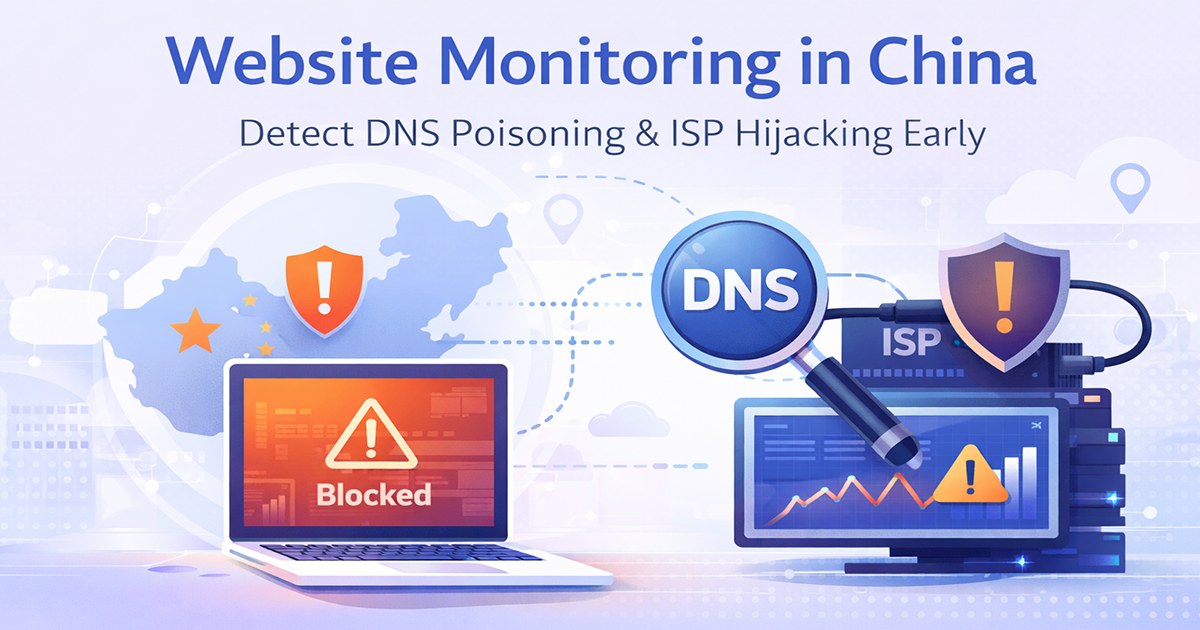
Introduction
If your website works perfectly everywhere except China, you’re not alone.
Many global businesses discover—often too late—that users in mainland China cannot access their services reliably. Pages load slowly, redirect to unexpected destinations, or fail entirely.
In most cases, the issue is not your infrastructure. It’s the network layer inside China.
The Hidden Problem: Your Monitoring Doesn’t See China
Most monitoring tools rely on global infrastructure such as AWS, GCP, or CDN edge nodes. From those locations, your website appears healthy.
But from inside China, your domain may resolve incorrectly, redirect users, or fail intermittently. Without visibility inside China, these issues remain invisible.
What Is DNS Poisoning
DNS poisoning is one of the most common blocking methods used by the Great Firewall (GFW).
When it happens, your domain resolves to incorrect IP addresses. Users are redirected or cannot access your service at all.
ISP Hijacking
Chinese ISPs such as China Telecom, China Unicom, and China Mobile may intercept traffic and redirect users to warning or anti-fraud pages.
This issue is more localized, more frequent, and harder to detect from outside China.
Why Detection Matters
You can’t fix what you can’t see.
Without proper detection:
- You don’t know when issues start
- You can’t measure impact
- You can’t validate recovery
How Weavebit Helps
- DNS poisoning detection from mainland China
- ISP hijacking monitoring across major carriers
- Flexible monitoring tasks and alert rules
- Real-time alerts via Telegram and email
- API integration for automation
Conclusion
If your users are in China, your monitoring should be too.
Start with a free DNS check, then enable continuous monitoring to protect your business.